
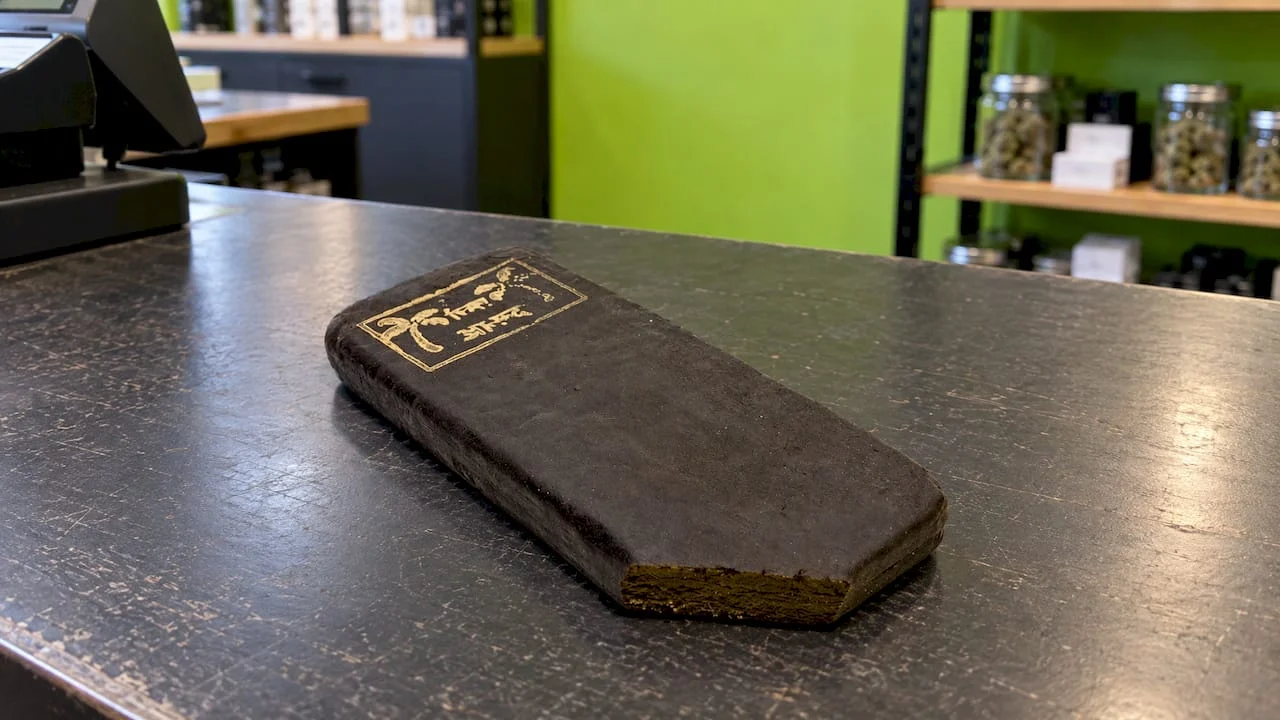
Mazar-i-Sharif hash is Afghan-style hashish, a pressed cannabis resin linked to the northern Afghan city of Mazar-i-Sharif and the Balkh region around it. It is usually dark, pliable and earthy, and it is different from the Mazar cannabis strain, which is a flower variety bred in the Netherlands. This guide explains the difference, how the hash is traditionally made, what to expect from its look, smell and flavour, and how to check a product you buy in Canada.
TL;DR
- Mazar-i-Sharif hash is cannabis resin (hashish) tied to northern Afghanistan. The Mazar strain is a separate hybrid flower.
- Traditional Afghan hash is made by sieving dried plants into resin powder, then warming and pressing it by hand. Methods vary by farmer and valley.
- Expect a dark surface, a softer and lighter interior, and an earthy, spicy, piney aroma.
- Hash is a concentrate, so it is more potent than flower by weight. Start with a very small amount.
- In Canada, buy products with a proper label: total THC and CBD, the yellow health warning, lot number and licence holder details.
Table of Contents
- What Mazar-i-Sharif hash is
- Mazar hash vs the Mazar strain
- How Afghan hash is traditionally made
- Appearance, aroma, flavour and texture
- Effects, potency and risks
- Canadian rules and how to read a hash label
- How to choose a Mazar-style hash
- Our perspective
- Where to find Mazar hash at East Van Buds
- FAQ
- Sources
What Mazar-i-Sharif hash is
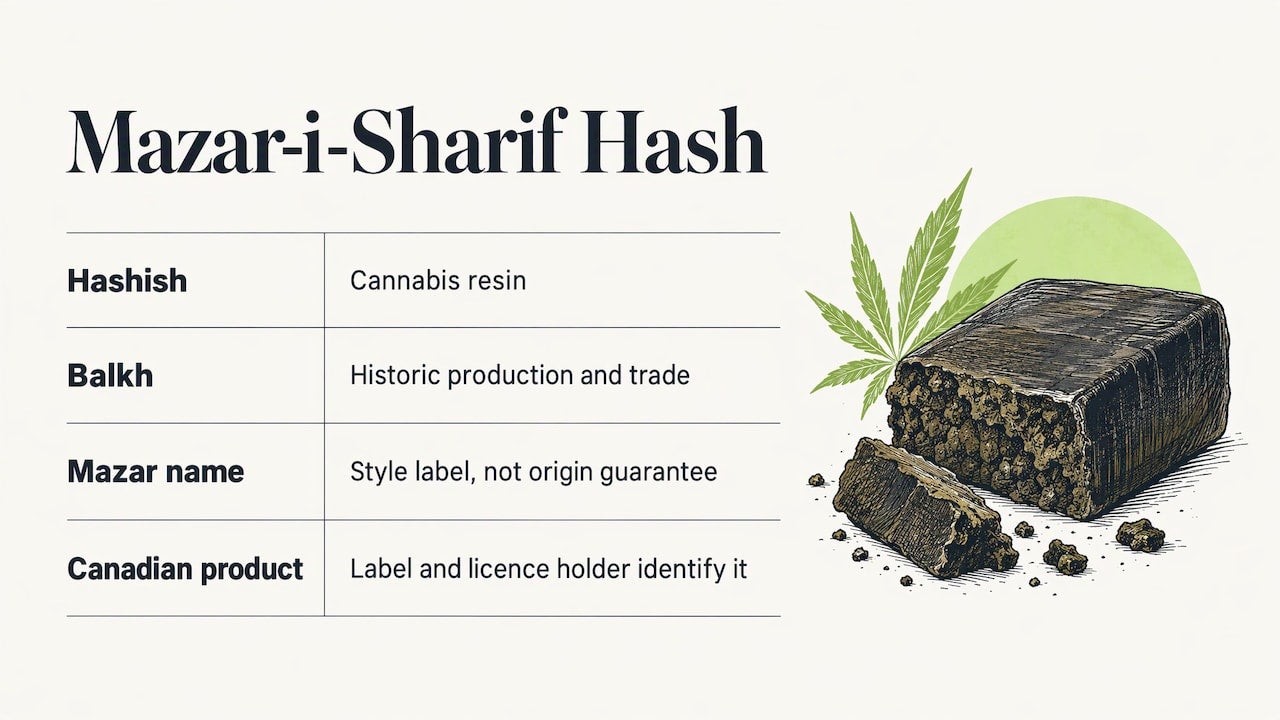
Hashish is cannabis resin: the sticky trichomes of the plant, collected and pressed together. The Afghanistan Analysts Network describes chars as cannabis resin and records Balkh, the province around Mazar-i-Sharif, as a historic area of production and trade.
So when a shop lists “Mazar-i-Sharif hash”, “Mazar-e-Sharif hash” or “Mazar Sharif hash”, it is using the name of a place as shorthand for a style: dark, pressed, Afghan-type resin. The spelling varies because the city’s name is transliterated from Dari in several ways. All of these spellings point to the same idea.
It helps to treat the name as a style label, not a guarantee of origin. The same Afghanistan Analysts Network history cautions against reading “Afghan” as a simple modern brand. Production and trade routes around Balkh, Mazar and neighbouring Central Asian regions have shifted over time. For a buyer in Canada, that means the name tells you what the product is modelled on, and the label and licence holder tell you what it actually is.
Mazar hash vs the Mazar strain
The two are easy to confuse because search results mix them together.
| Mazar-i-Sharif hash | Mazar strain | |
|---|---|---|
| What it is | Pressed cannabis resin (a concentrate) | A cannabis flower variety |
| Link to Afghanistan | Named for the region and its hash tradition | Built from Afghani genetics |
| Where it was developed | Traditional hash-making areas of northern Afghanistan | The Netherlands, in the 1980s |
| How it is used | Crumbled or warmed, then smoked or vaporized | Flower, smoked or vaporized |
Royal Queen Seeds says modern Mazar is a hybrid created in the Netherlands in the 1980s from Afghani landrace genetics and Skunk #1, rather than a pure landrace, and that commonly offered versions sit at roughly 13 to 20% THC. That is a flower figure. Hash is concentrated resin, so the two numbers should never be compared directly.
If you prefer flower with that heavy, relaxing character, our indica flower selection is the place to look. If you want the resin itself, keep reading.
How Afghan hash is traditionally made
There is no single recipe, and that is part of the appeal. Cannabis Now describes Afghan hash as a traditional product tied to place: it says Mazar-i-Sharif is home to famous Afghan hashish, that farmers select resin-rich plants, and that growing, sieving and curing techniques differ by farmer and valley.
The broad outline is consistent across accounts:
- Select and dry the plants. Resin-rich plants are chosen and dried.
- Sieve. Dried plant material is shaken or screened through fine cloth so the resin powder falls free. This powder is often called garda. A Czech trade account says dried indica buds are shaken through a fine cloth to produce this kief.
- Warm and work it. The same account says the powder is heated and moistened with hot water or tea, then kneaded by hand until it turns dark brown to black and becomes sticky, like plasticine.
- Press. Vice’s report from Afghanistan describes repeated sifting, then pressing and warming so the oils are released. Finished Afghan hash commonly has a dark surface and a lighter interior.
This is dry sifting. It uses no solvent, only mechanical separation and heat. That is one reason hash is often described as one of the oldest cannabis concentrates.
For a wider look at hash types and methods, including bubble hash and pressed hash, see our guide to cannabis hash origins, production and consumption methods.
Appearance, aroma, flavour and texture
Most descriptions agree on the main points, though individual blocks differ.
Appearance. The Czech trade account describes Afghan hash as having a black surface and a dark brown interior. High-quality blocks are soft and easy to mould at room temperature, with a fresher, lighter brown-green inside. The surface turns black as air reaches it over time.
Texture. When fresh, it is soft and can resemble fudge. It hardens with air exposure. In general, hashish ranges from brittle to malleable and often softens or turns sticky when warmed by hand. Texture is a sign of storage and age as much as origin.
Aroma. The same Czech source lists pepper, incense, earth, sandalwood and pine resin. Spicy and pungent are the common words.
Flavour. Mainly earthy and spicy, with hints of molasses or burnt sugar and light herbal or tea notes.
Ageing. One enthusiast history says Afghan hash is often aged, wrapped and stored in a cool, dark place for months or longer to smooth the flavour. Treat that as a traditional practice, not a rule. Today, follow the storage instructions on the package.
What the terpenes have to do with it
Terpenes are the aromatic compounds in cannabis that shape smell and taste. Afghan-type genetics are generally associated with earthy, pine and spice notes. A hash that keeps more of its terpenes tends to smell stronger and taste richer, which is why a fresh, well-stored block is worth more than a dry, crumbly one.
Effects, potency and risks
Hash is a concentrate, so it carries more THC per gram than most flower. Health Canada explains that THC causes the intoxicating and impairing effects of cannabis and has addictive potential. Immediate effects can include euphoria, dizziness, a faster heart rate, changes in thinking, anxiety, panic or paranoia, increased appetite, impaired memory and attention, dry mouth, red eyes and drowsiness.
The Mazar name is often paired with “heavy” and “relaxing” in reviews. Those are personal reports, and they depend on the dose, your tolerance and the particular product. They are not a promise.
Using hash with care
Canadian lower-risk use guidance notes that concentrates have particularly high THC contents, so the risks of high THC apply to concentrates and in some cases more so. Practical steps that follow from that:
- Start with a piece the size of a grain of rice or smaller. Wait before taking more. Concentrates are potent for their size, so your usual flower amount is not a guide.
- Pace yourself. If you are new to hash, ask yourself whether a lower-THC product would suit you better first.
- Do not drive or operate machinery after using. Impairment affects attention and reaction time.
- Keep products locked away from children and pets, in the original child-resistant packaging.
- If you feel anxious or unwell, sit somewhere calm, drink water and wait. If symptoms are severe, such as chest pain, confusion or fainting, call 911 or your local poison centre.
- Talk to your doctor or pharmacist before use if you are pregnant, have a heart or mental health condition, or take prescription medication.
Smoking hash involves combustion, which produces smoke. Vaporizing at lower temperatures is an option some people choose to avoid it. Whichever method you use, keep the dose small.
Canadian rules and how to read a hash label
Possession limits
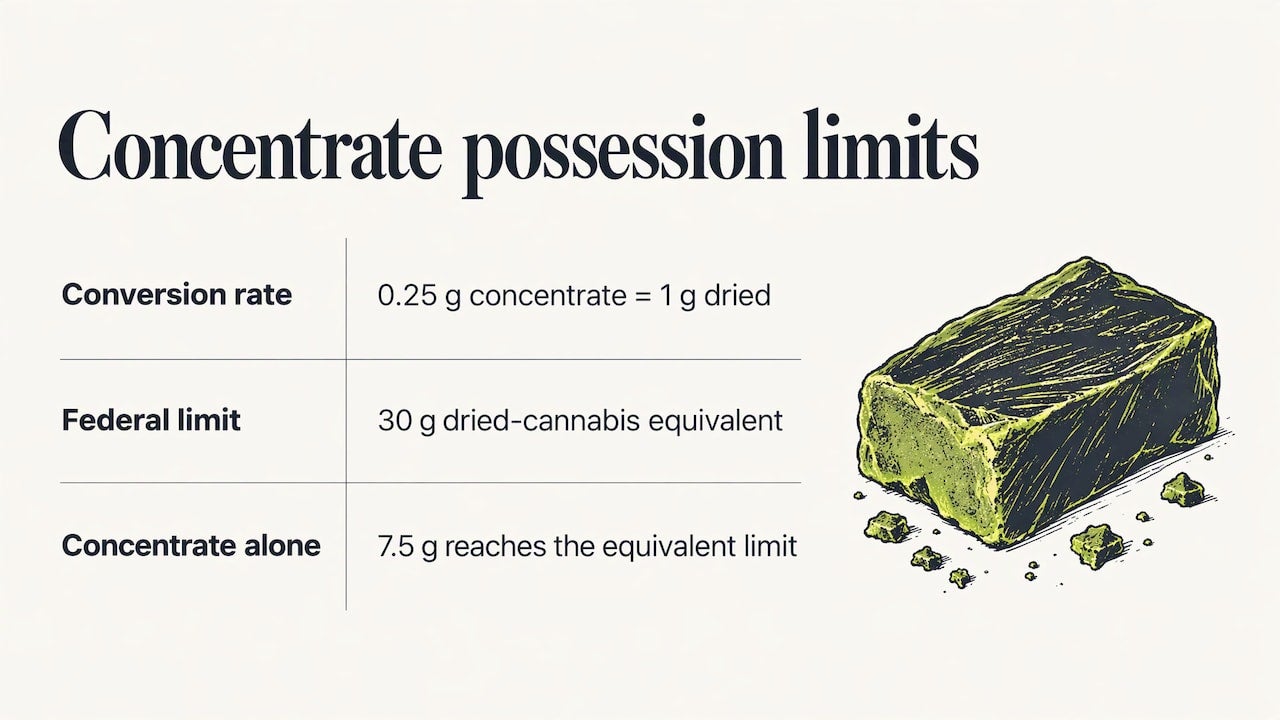
Health Canada treats hash as a cannabis concentrate. Its public possession calculator counts 0.25 grams of concentrate as equal to 1 gram of dried cannabis. The federal public limit is 30 grams of dried cannabis equivalent, which works out to 7.5 grams of concentrate if you carry nothing else. Provinces and territories set their own rules on minimum age, where you can use cannabis and home storage, so check your local rules before you travel with it.
What a legal label shows
A legal product is packaged and labelled. Health Canada says labels must show total THC and CBD, a yellow-box health warning, the licence holder’s contact information and the lot number. Packages must also carry a keep-out-of-reach-of-children warning.
A clinical framework for evaluating cannabis products adds a checklist worth using at the point of purchase. Look for product type, producer or distributor, contact details, cannabinoid content, warnings, storage details, expiry date, lot number, net weight and child-resistant packaging. It also recommends evidence of third-party testing, such as a certificate of analysis covering pesticides, microbes and heavy metals.
In short: an unlabelled block with a romantic story is not the same thing as a labelled product from a licensed source.
How to choose a Mazar-style hash
Use these points when you compare products:
- Check the label first. THC percentage, lot number and licence holder should all be visible.
- Match the THC figure to your experience. A higher number means a smaller dose.
- Look at the description. Notes of earth, spice, pine or incense fit the traditional Afghan profile.
- Consider the format. Pressed hash is usually sold in grams. Choose the size you will use while the product is fresh.
- Think about how you will use it. Some people crumble it into a bowl, others use a vaporizer made for concentrates. Use the method you already know.
- Read ratings. Customer ratings can show how a batch has been received.
Our perspective
We think hash deserves the same care as any other product people put in their body, and that starts with knowing what you are buying. A name like Mazar-i-Sharif carries history, but a history is not a label. We want customers to see the product type, the producer and the details they need before they order.
Our approach is no-bunk, no-filler. That means a clear catalogue, honest descriptions and discreet, fast delivery across Canada, so ordering feels simple. Our customers range from people trying hash for the first time to those who have been choosing resin for years. We aim to give both groups the information to choose well.
If you like the earthy, spicy, classic Afghan profile, start with the Mazar-style hash on our shelves. If you want something different, our bubble hash options take a different route to the same resin-based idea. Whatever you pick, begin with a small amount and take your time.
the author
Where to find Mazar hash at East Van Buds
We stock several Mazar-style hashes. You can look at Jungle Ridge Mazar-I-Sharif Hash, Hive Mazar-E-Sharif Hash and Hive Afghanistan Mazar Hash. Each page shows the product details and customer ratings, so you can compare before you order.
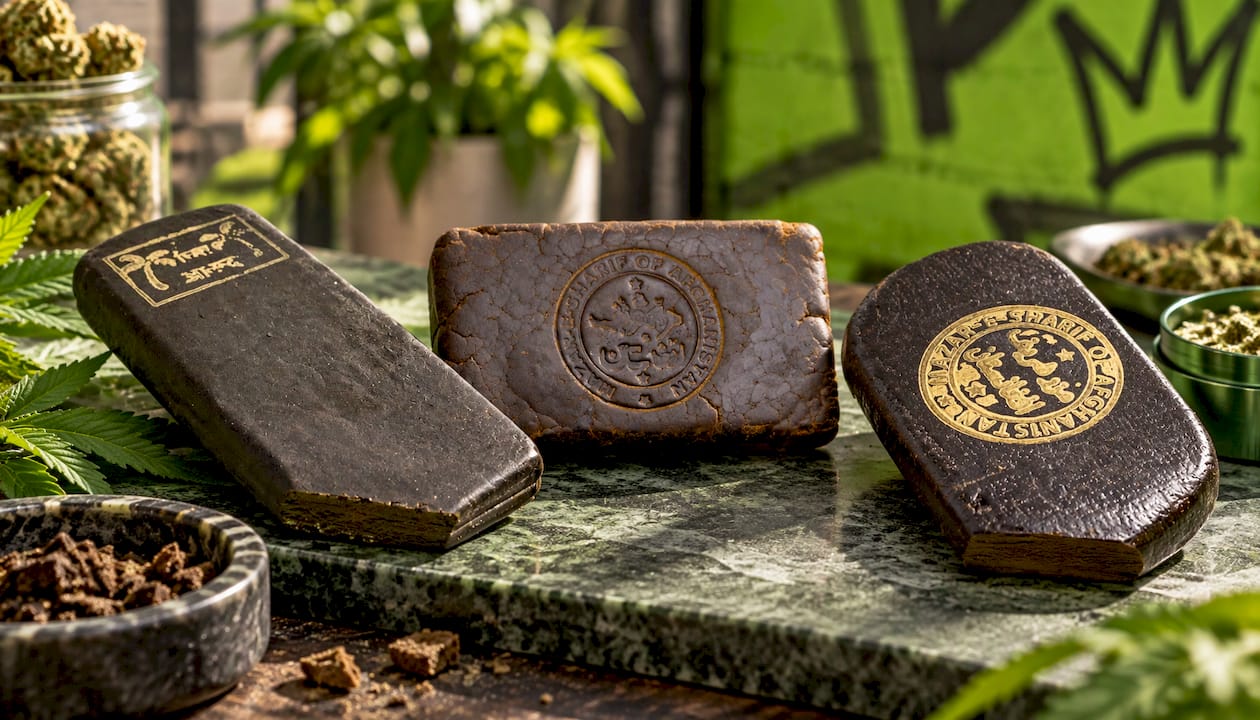
Want to see more? Browse our full hash category or the rest of the East Van Buds catalogue, which includes flower, edibles, vapes, concentrates, CBD and topicals, and accessories. We ship discreetly across Canada. If you buy often, our bulk category may suit you.
FAQ
Is Mazar-i-Sharif hash the same as the Mazar strain?
No. The hash is a pressed cannabis resin linked to northern Afghanistan. Mazar the strain is a hybrid flower bred in the Netherlands from Afghani genetics and Skunk #1. They share a name and an earthy character, but they are different products.
How strong is Mazar-i-Sharif hash?
It varies by product, so read the total THC on the label. As a concentrate, hash is generally stronger than flower by weight, which is why a very small first dose is sensible. Effects can include relaxation but also anxiety, dizziness and impaired memory and attention.
How much hash can I carry in Canada?
The federal public limit is 30 grams of dried cannabis equivalent. Health Canada counts 0.25 grams of concentrate as 1 gram of dried cannabis, so that equals 7.5 grams of hash if you carry nothing else. Provincial and territorial rules on age and use can differ.
What should Mazar hash smell and look like?
Traditional Afghan hash is dark, often black on the surface with a lighter brown interior. It is soft and mouldable when fresh and hardens with air. The aroma is earthy and spicy, with notes of pine, incense or sandalwood.
How do I know a hash product is legal and tested?
Check the label for total THC and CBD, the yellow health warning, the licence holder’s contact details, the lot number and child-resistant packaging. Third-party test results, such as a certificate of analysis, add further confidence.
Sources
- The Myth of ‘Afghan Black’: a cultural history of cannabis and hashish in Afghanistan (Afghanistan Analysts Network)
- Mazar: An Indica Strain With Central Asian Influences (Royal Queen Seeds)
- A Glimpse Into Afghanistan’s Traditional Cannabis Culture (Cannabis Now)
- Traditional types of hashish (Cannab2b)
- I Went On a Weed Tour of Afghanistan (Vice)
- Hashish (Cannabis Resin): Definition, History, and Production Methods
- Consumer information: Cannabis (Health Canada)
- Lower Risk Cannabis Use Guidelines for youth (University of Victoria CISUR)
- Online calculator: Limits for public possession of cannabis (Health Canada)
- How to read and understand a cannabis product label (Health Canada)
- A Clinical Framework for Evaluating Cannabis Product Quality and Safety