
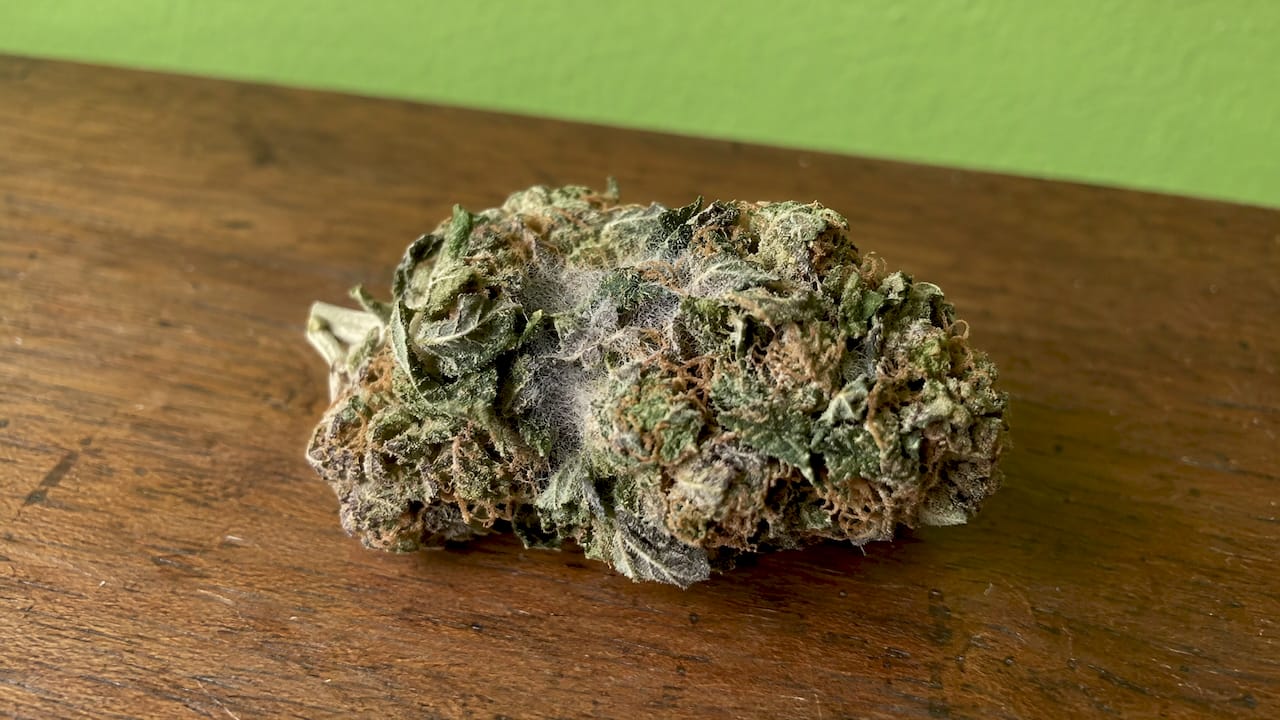
Mouldy cannabis usually shows itself in three ways: a grey-white or dark fuzzy coating that does not sparkle, a musty smell like damp hay or a wet basement, and buds that feel damp, spongy or oddly crumbly. If you see or smell any of these, do not smoke, vape or cook with it. This guide explains what each sign looks like, how to tell mould from trichomes, what to do with a suspect batch and how to store your flower so it stays fresh.
TL;DR
- Look for a white, grey or greenish powdery or web-like coating, dark spots, and buds that are slimy or mushy inside.
- Smell it: mould smells musty, like wet hay, a damp basement or ammonia, not like the terpenes (the aroma compounds) of the strain.
- Trichomes sparkle and look like tiny crystals on stalks. Mould looks flat, fuzzy or chalky and spreads in patches.
- If you can see or smell mould, throw the whole batch out. Cutting off the affected part does not make the rest safe.
- Store flower in an airtight glass jar, in the dark, at roughly 59% to 63% relative humidity, and keep it out of the fridge.
Table of Contents
- What mouldy weed looks like
- Mould vs trichomes: how not to mix them up
- The smell test
- Texture and feel
- Mould, mildew and bud rot: are they different?
- Why mouldy cannabis is a health concern
- What to do with cannabis you think is mouldy
- How to store flower so mould does not start
- What about old weed?
- Perspective: why we pay attention to this
- Choosing legal, tested products
- A note on vape cartridges
- Shop with East Van Buds
- FAQ
- Sources
What mouldy weed looks like
Healthy flower has some variety in colour: greens, purples, orange or rust-coloured pistils, and a frosting of resin. Mould interrupts that pattern. Healthline describes mouldy cannabis as having a greyish-white powdery coating and a musty or mildewy smell, and advises throwing it out if you can see mould or mildew.
Here are the visual signs to check in good light, ideally with a phone camera zoomed in:
- White or grey powder. A dusty film that looks like flour or talc, often on the leaves or between the bud’s folds. This is the typical look of powdery mildew.
- Cobweb-like strands. Fine, wispy white threads that stretch between parts of the bud.
- Dark patches. Black, brown or grey-green spots that look dull rather than glittery.
- Slimy or mushy areas. A bud that has gone soft, wet or slick, especially near the stem.
- Unusual discolouration. A grey-green cast across the bud, where the flower should look vibrant. A company guide from Atrium lists unusual spots and a greyish-green colour among the warning signs.
One thing to remember: a few of these signs can also be a normal part of a poorly trimmed or old bud, such as dull colour. That is why no single sign should be judged alone. Combine what you see with what you smell and feel.
Mould vs trichomes: how not to mix them up
This is the question most readers have, and it is a fair one. Trichomes are the tiny resin glands that cover good flower. Under a magnifier they look like little glassy stalks with round heads. To the naked eye they look like a fine sugar frosting. Healthline notes that mouldy cannabis can be mistaken for trichomes, so appearance alone is not enough. A combination of visual and smell cues is the reliable approach.
Use this comparison:
| Feature | Trichomes | Mould |
|---|---|---|
| Appearance up close | Glassy, crystal-like stalks with round heads | Flat, fuzzy, powdery or web-like growth |
| Colour | Clear, milky or amber | White, grey, grey-green, black |
| Shine | Sparkles under light | Dull, chalky |
| Pattern | Evenly spread across the bud | Patchy, spreading in spots or strands |
| Smell | Strain aroma: citrus, pine, fuel, sweet | Musty, mildewy, damp |
| Touch | Sticky or tacky | Damp, spongy, or powdery and dusty |
A simple test: if you gently rub a spot and it smears into a dusty film or you can see thread-like strands, treat it as mould. Trichomes will feel sticky and will not smudge into powder.
The smell test
Smell is often the quickest warning. Cannabis that is fresh smells of its terpenes, which can be fruity, earthy, piney or gassy depending on the strain. Norddampf, a vaporizer retailer’s guide, describes mouldy cannabis as smelling like wet hay, a damp basement or ammonia instead of terpenes.
Signs that the smell has gone wrong:
- A musty, stale or mildewy odour that you would not expect from the strain.
- A faded aroma replaced by something sour or chemical.
- A smell that gets stronger and more unpleasant when you break the bud open.
That last point matters because mould can sit deep inside. The same Norddampf guide explains that mould often takes hold inside dense buds, so a clean surface does not guarantee a clean core. Break larger buds apart and smell the inside before you grind them.
Texture and feel
Good flower is slightly springy. It should break apart with a gentle squeeze and not feel wet. The Atrium guide mentions a damp or spongy texture, or flower that crumbles too easily, as an unusual texture to watch for. Both can point to a humidity problem: too much moisture invites mould, while very dry, crumbly flower has been stored badly and has lost much of its aroma.
Dry and crumbly flower is not always mouldy, but it tells you the storage was poor. Check it carefully for the other signs.
Mould, mildew and bud rot: are they different?
They are related terms, and on a consumer level the message is the same. Mildew, such as powdery mildew, is a type of mould that tends to appear as a white or grey powder. Bud rot is another form, caused by mould that develops inside dense flower.
Leafly explains that bud rot develops in the dense core of a bud, starting at the stem inside and spreading outward. It typically appears first as something white and wispy, then turns grey and black as the bud becomes mushy and slimy. The same page says that once a bud begins to mould it is no longer safe to consume and must be discarded.
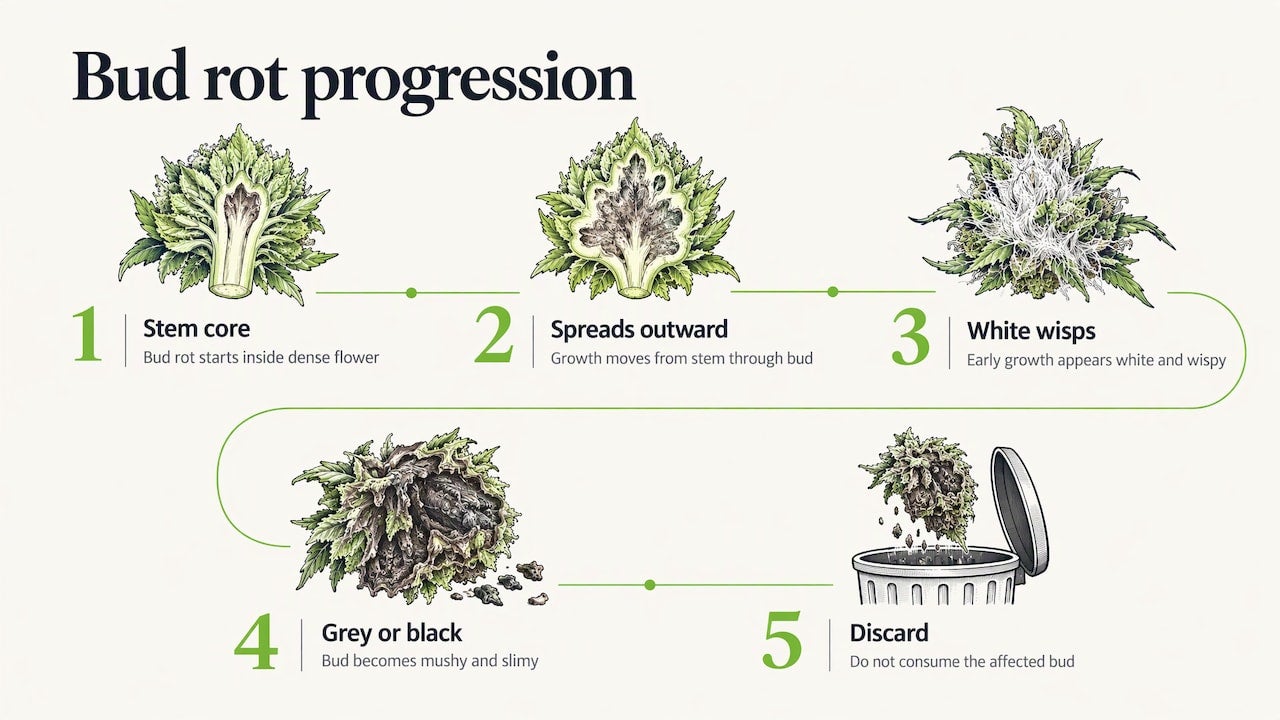
What this means for you as a buyer: bud rot can hide inside. A bud that looks fine from the outside but is brown, grey or slimy in the middle should be discarded, as should any other flower that was stored with it.
Why mouldy cannabis is a health concern
Smoking or vaping contaminated flower brings spores and other microbes directly into your lungs. The effects depend on the person, and people with allergies, asthma or weakened immune systems should be especially careful. If you have a lung condition or a compromised immune system and have used cannabis you think was mouldy, speak to your doctor or pharmacist, or call your local poison control centre if you feel unwell.
Health Canada recall notices show what regulators say about mould exposure. A recall for a lot of Cloudz 7g dried cannabis states the product may contain mould and lists possible temporary allergic symptoms: sneezing, coughing, wheezing, runny nose or congestion, and watery or itchy eyes. A recall of Full Sesh Purple Gelato Punch says Health Canada’s data gathering program found the lot did not meet microbial contaminant limits for yeast, mould and bacteria. A third recall, for a pre-roll product, reports the same kind of temporary symptoms.
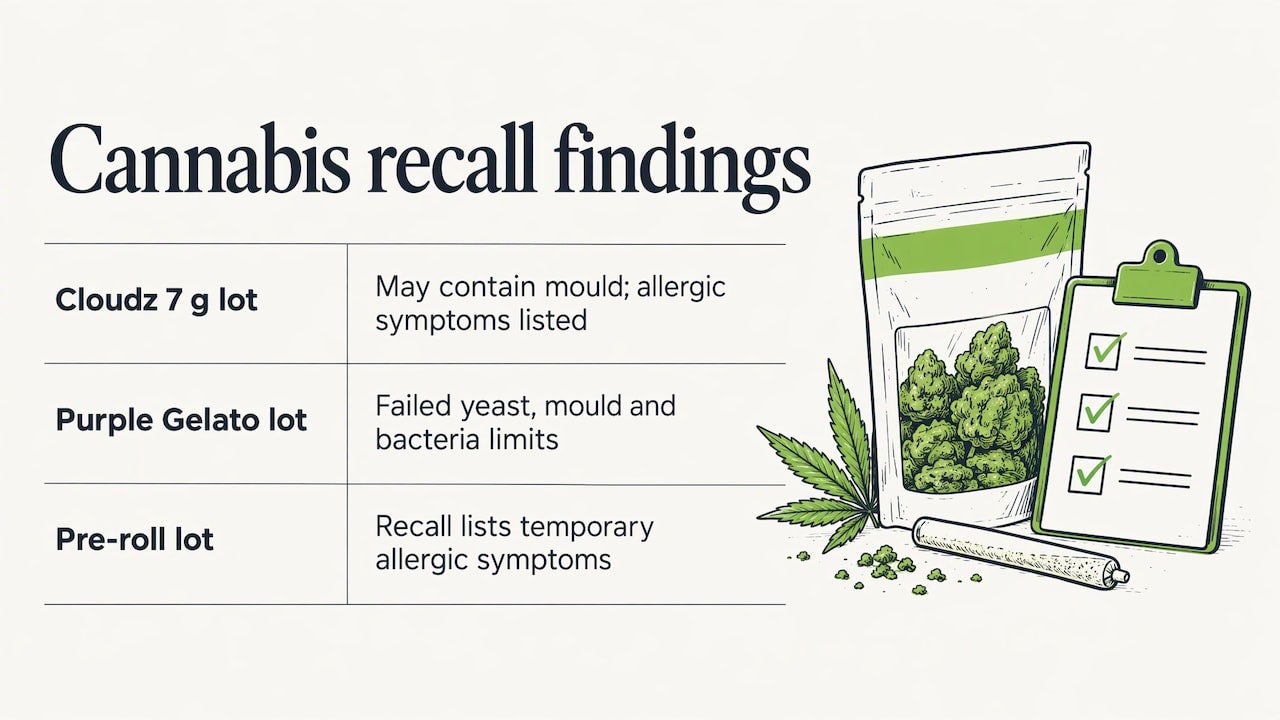
These notices also show that mould is not only a black-market issue or a problem with old flower. It can affect a single production lot, which is why checking the lot and packaging matters.
What to do with cannabis you think is mouldy
- Stop. Do not smoke, vape, bake or make butter with it, even if you plan to heat it.
- Do not cut off the bad part. Homegrown Cannabis explains that spores travel through the flower, so a clean-looking section may still carry mould. The safe choice is to discard the whole batch.
- Seal and bin it. Put it in a bag and throw it out. Do not leave it open, because spores can spread to other jars.
- Clean the container. Wash glass jars and grinders thoroughly and let them dry before reuse.
- Check the rest of your stash. Look at flower stored nearby for the same signs.
- Report a legal product. If the product was bought from a licensed seller and you believe it is contaminated, you can report it to Health Canada and tell the seller. Recalls are posted on the Government of Canada recalls site.
If you feel unwell after using cannabis you suspect was mouldy, with breathing trouble, a persistent cough or wheezing, see a doctor.
How to store flower so mould does not start
Most mould at home comes from moisture. Good storage is simple. Healthline recommends an airtight glass container in a dark, dry place at 59% to 63% relative humidity and just below 77°F (25°C), and it advises against the fridge or freezer. Norddampf gives the same humidity range and says temperature swings in cold storage cause condensation.
A practical routine:
- Use glass jars with tight lids. Plastic bags let in air and can hold static, which strips resin.
- Add a humidity pack designed for the 59% to 63% range if your home is humid or very dry. A small hygrometer shows you what is happening inside the jar.
- Keep jars in a cupboard, away from sunlight, stoves, radiators and bathrooms.
- Do not open the jar more than needed. Each opening lets in room air.
- Buy amounts you will use. Smaller quantities finish before they have a chance to go stale. Bulk buyers should divide a larger purchase into several jars.
- Date your jars. Write the purchase date on a label so you know how old each one is.
Vancouver and the wider BC coast are damp for much of the year, so it is worth paying extra attention to humidity if you live there. Wet-season weeks are when a loosely closed jar is most at risk.
What about old weed?
Readers often ask whether a bud that is a couple of years old is still fine. Age alone is not a reliable indicator. What matters is how it was stored and what it looks, smells and feels like now. Properly stored flower will gradually lose aroma and potency, and may become dry and harsh. Poorly stored flower may grow mould much sooner. Apply the same checks: if you see growth, smell mustiness or feel dampness, discard it. If it is simply dry and has little scent, it is past its best, but check it carefully before use, and when you have any doubt, do not use it.
Perspective: why we pay attention to this
We sell flower, edibles, vapes and concentrates to customers across Canada, and the most common worry we hear from people buying online is simple: how do I know what I am getting?
Our answer starts with the standard we set for ourselves. We aim for no shortcuts in sourcing and delivery, and a no-bunk, no-filler approach to what goes in the catalog. Mould is a good example of why that matters. You cannot always see it, and you cannot fix it after the fact, so quality has to be handled before the product reaches you.
We also believe an informed customer is a better customer. Knowing what trichomes look like, what a healthy smell is and how to store flower means you enjoy what you buy for longer. It is also the reason we publish product ratings, so buyers can see how other customers have found a strain or product.
If anything arrives and does not look, smell or feel right, do not use it. Contact our team and we will help.
the author
Choosing legal, tested products
The best protection against mould is buying from a regulated source. Health Canada states that legal cannabis is quality controlled and tested for harmful levels of contaminants, and that it is tested for THC and CBD accuracy. It contrasts this with illegal cannabis, which may contain harmful levels of contaminants including mould. The Québec government makes the same point in its lower-risk use guidance, describing legal products as having undergone quality controls and carrying tested THC and CBD levels on the package.
When you receive a product, look for what Health Canada lists on legal packaging:
- An excise stamp.
- A yellow box with a health warning in English and French.
- A standardized THC symbol.
- Child-resistant packaging (except for plants and seeds).
- A nutrition facts table for edible cannabis.
Check the packaging is sealed and undamaged on arrival. If the package smells musty before you open it, do not use what is inside.
A note on vape cartridges
Mould is mostly a flower issue, since cartridges contain extracted oil, but many readers ask about “additive-free” cartridges when they are thinking about purity. The term is not a defined category, so the useful step is to read the label. Health Canada’s notice guide says licence holders should include ingredient information that is listed on the label, and that a change to labelled ingredients counts as a new product requiring a new notice. The Ontario Cannabis Store says cartridges list cannabinoid content in milligrams per gram.
When you shop for cartridges, check:
- The ingredient list on the package or product page.
- The cannabinoid content per gram.
- The size, such as 1 g or 1.2 g.
- Whether the packaging is intact and sealed.
For a closer look at the range we carry, see our In House refill cartridge, the KleerX distillate cartridge and the Elements cartridge.
Shop with East Van Buds
If you want discreet delivery across Canada from a catalog with ratings you can read, East Van Buds carries flower, edibles, vapes, concentrates, CBD and topicals, accessories and bulk options. You can browse everything on our main shop page and look at the bulk range under our bulk category.

If you are new to ordering online, our mail order guide explains how shipping works, and our Vancouver cannabis FAQ answers common delivery and product questions.
FAQ
Is bud rot the same as mould?
Bud rot is a type of mould that forms inside dense buds. It often starts at the inner stem as white, wispy growth and turns grey or black as the bud goes mushy. Both mean the flower should be discarded.
Can I smoke weed if I cut off the mouldy part?
No. Spores can travel through the flower, so the parts that look clean may still be affected. The safest choice is to throw out the entire batch and clean the container.
Is mildew worse than mould?
Mildew is a kind of mould, usually seen as a white or grey powder. For a consumer the advice does not change: if you see either one, do not use the cannabis.
What if my flower is just dry and has no smell?
Dry, odourless flower has lost its terpenes and is past its best, but that is different from mould. Look closely for powder, webbing, dark spots or a musty smell before deciding. If you are unsure, discard it.
How should I store cannabis to prevent mould?
Keep it in an airtight glass jar in a cool, dark, dry place at about 59% to 63% relative humidity. Avoid the fridge and freezer, since temperature swings cause condensation.
Sources
- Moldy Weed: What to Look for and How to Handle It (Healthline)
- How to identify and avoid buying moldy weed (Atrium)
- How to Spot Moldy Cannabis: Safety and Prevention (Norddampf)
- Identifying Bud Rot, Mold & Root Rot on Marijuana Plants (Leafly)
- Moldy Weed: How to Spot It and Keep Your Buds Fresh (Homegrown Cannabis)
- Reduce your risk: Choose legal cannabis (Health Canada)
- Lower-risk cannabis use (Gouvernement du Québec)
- Blizza Brands Inc. recalls one lot of Cloudz 7g (Government of Canada)
- Sirona Pharma Inc. recalls one lot of Full Sesh Purple Gelato Punch (Government of Canada)
- Culture Kizos inc. recalls Coterie Double-Infused Fruity Pebbles Blunt (Government of Canada)
- Notice of new cannabis product guide (Health Canada)
- OCS & Cannabis: FAQ (Ontario Cannabis Store)